Commercial · Trafalgar Heights
Commercial Rekeying in Trafalgar Heights
The manager's key ring went missing somewhere between the bank and the car, and the master on it opened every door in the building. Until the cylinders are changed, whoever finds it is holding the run of the place.
Commercial Rekeying
In plain words
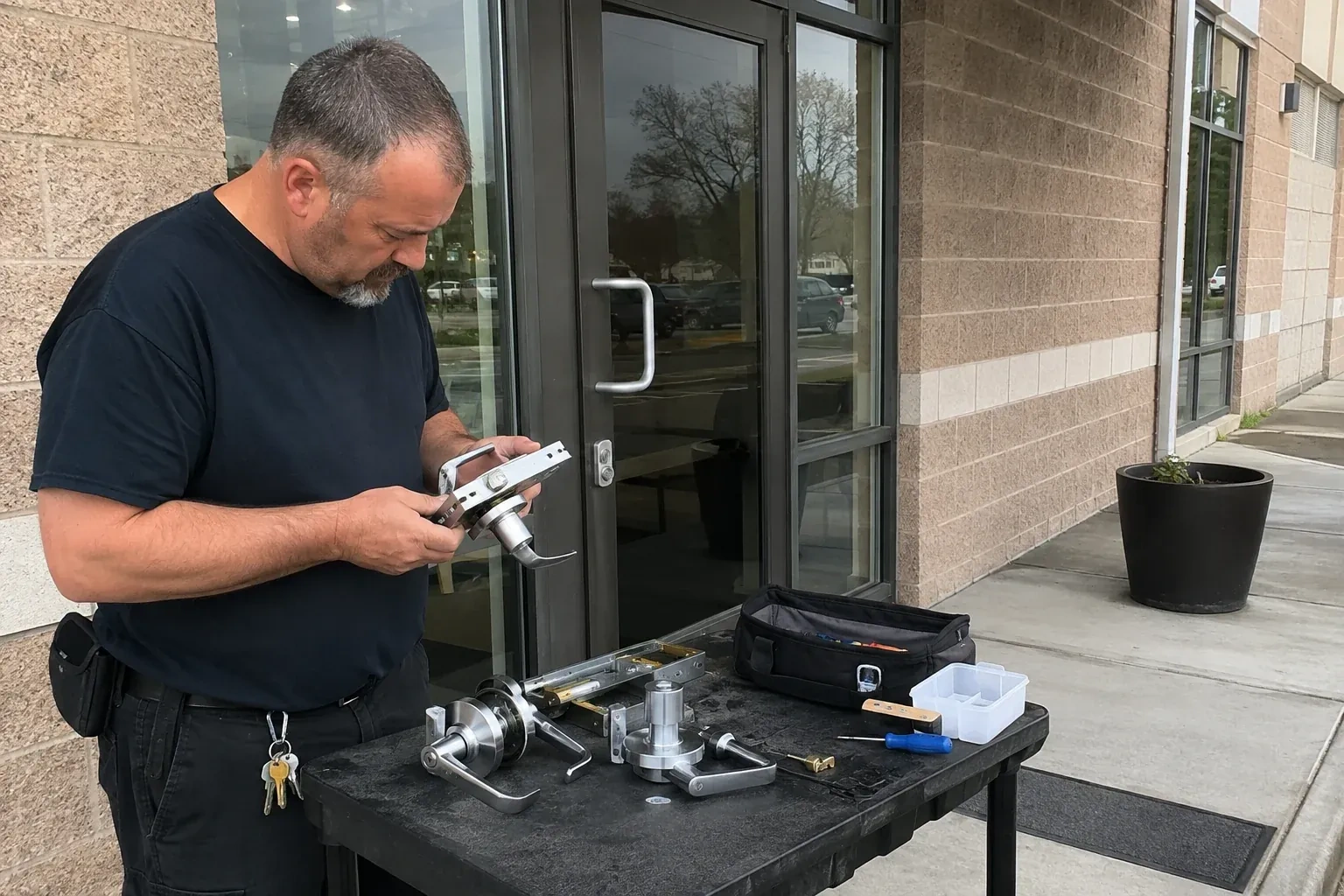
Commercial rekeying changes the pins inside a business's existing lock cylinders so that a new key operates them and every earlier key stops working, while the hardware itself stays on the door. The locksmith works from a list of the openings the business controls and the people who need to pass through each one, sets the cylinders to fresh combinations, cuts keys to match and records which key opens which door. Because nothing is replaced unless it is worn, a whole premises can be brought back under control in one scheduled visit, with the doors locking and unlocking exactly as before but answering only to keys you have counted.
How the visit goesYou have just signed the lease on a unit the previous tenant ran for a decade. The landlord handed over three keys, the back door wears a padlock nobody can open, and nobody can say how many front-door keys are still out there.
Trafalgar Heights
How the visit goes
Which doors are the landlord's
In a plaza, an office building or a multi-tenant industrial unit, some doors on your floor plan are not yours to rekey. Corridor doors, electrical and mechanical rooms, shared loading doors and the building's fire exits usually sit on the landlord's master system, and a suite entrance may be required to accept the landlord's key as well as yours. The locksmith sorts the openings into two columns before starting: those the lease puts under your control, which get the new plan, and those that stay as they are or need the property manager's say-so. Where a suite door must accept both a tenant key and the building master, it is pinned to do exactly that.
Swapping interchangeable cores
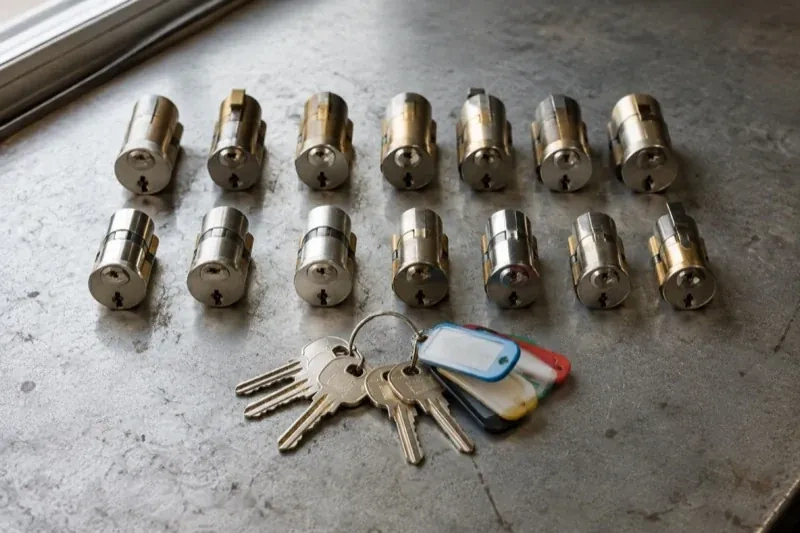
Where the business already runs on interchangeable cores, the door hardware never comes apart. The control key goes into the figure-eight core, turns a few degrees, and the whole core slides out of the lever or padlock in one piece. A freshly combinated core goes in the same way, the operating key is tried, and that door is done. The old cores travel back to the bench to be repinned for another opening or held as spares. This is what makes cores so well suited to businesses with steady turnover: a single control key, kept in the manager's safe rather than on a ring, is all it takes to change a lock.
Keys counted into named hands
Alongside the chart comes a key register: each key's stamped code, the person it was issued to, the date, and a line for the date it comes back. Filling it in as keys are handed out on the first morning takes ten minutes and pays off at every departure afterwards, because the question becomes 'return key A-07' rather than 'did she have a key?'. Spare keys are counted too and kept somewhere locked rather than in the drawer where the old tangle lived. When the register and the chart agree with the keys on the hook, the business knows exactly who can open it, which is the whole point of the exercise.
Commercial Rekeying
In the van
- Code key machine
- Mortise cylinder set screws and cams
- Standard and restricted key blanks
- Dry graphite or PTFE lubricant
- Key stamp set and tags
What affects the quote
Same fees day, night or weekend
1Number of cylinders
The count of openings drives the quote more than anything else: each cylinder is removed, repinned, refitted and tested individually, so a three-door shop and a twelve-office suite are very different jobs.
2Interchangeable cores versus repinning
Cores swapped with a control key are the shortest work on site, while cylinders that must come apart on a bench take longer. Supplying spare cores for the manager to hold is priced as its own line.
3Documentation and register
A keying chart, a key register and stamped codes on every key are part of a proper commercial rekey, and the quote names the paperwork so it is never skipped.
Commercial Rekeying: questions
What is a master key system and does a small business need one?
In a master key system each lock accepts its own change key and also a master key above it, so a manager carries one key while staff carry keys that open only their own doors. Small businesses with three or four doors often manage without one. A master earns its place once there are several rooms with different people in them, or several locations, and the owner would otherwise carry a ring of keys.
What is an interchangeable core and why is it suggested for staff turnover?
A small-format interchangeable core is a small figure-eight cylinder that slides out of the lever, deadbolt or padlock when a control key is turned, with no tools needed; larger doors sometimes use a large-format core with a different profile instead. A manager keeps the control key in the safe and a few spare cores on hand, so a missing key means the core is swapped in moments and repinned later. For a business with frequent staff turnover, it turns a call-out into a routine.
Do I need my landlord's consent before rekeying my unit?
Read the lease, because that is where the answer lives. Commercial tenancies are governed mostly by the lease itself, and many leases require the tenant to tell the landlord when locks change, to provide a key for emergencies, or to use the landlord's approved locksmith. Doors on the building's master system, such as corridor or service doors, are normally the landlord's to change. Bring the lease to the assessment and the locksmith will sort the doors accordingly.
Commercial Locks
- Access Control InstallationYou just leased the empty unit next door and want the new tenant to open their own suite without a…
- Panic & Exit HardwareSomeone at the front counter always has to unlock the side door by hand before the lunch rush…
- Commercial-Grade Lock ReplacementThe kitchen delivery door gets shouldered open more than a hundred times a shift, and lately the…
Commercial Rekeying near you
These are the services we bring to doors across Trafalgar Heights. Residential work covers lockouts, rekeying, lock replacement, deadbolts, smart locks and older hardware brought back to life. Commercial work covers storefront doors, exit devices, closers, master keys and safes. Vehicle key cutting rounds out the list when it is needed.